
- About
- Our Design Process
- MoreHide
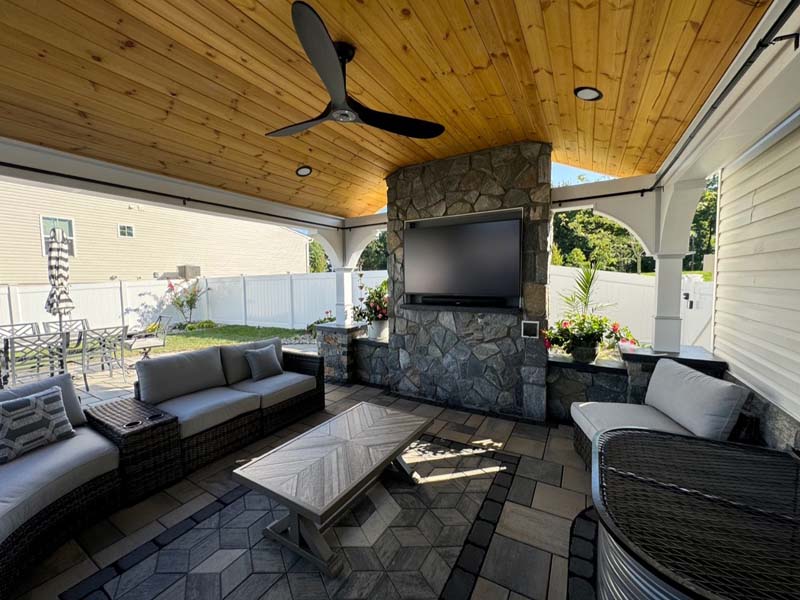
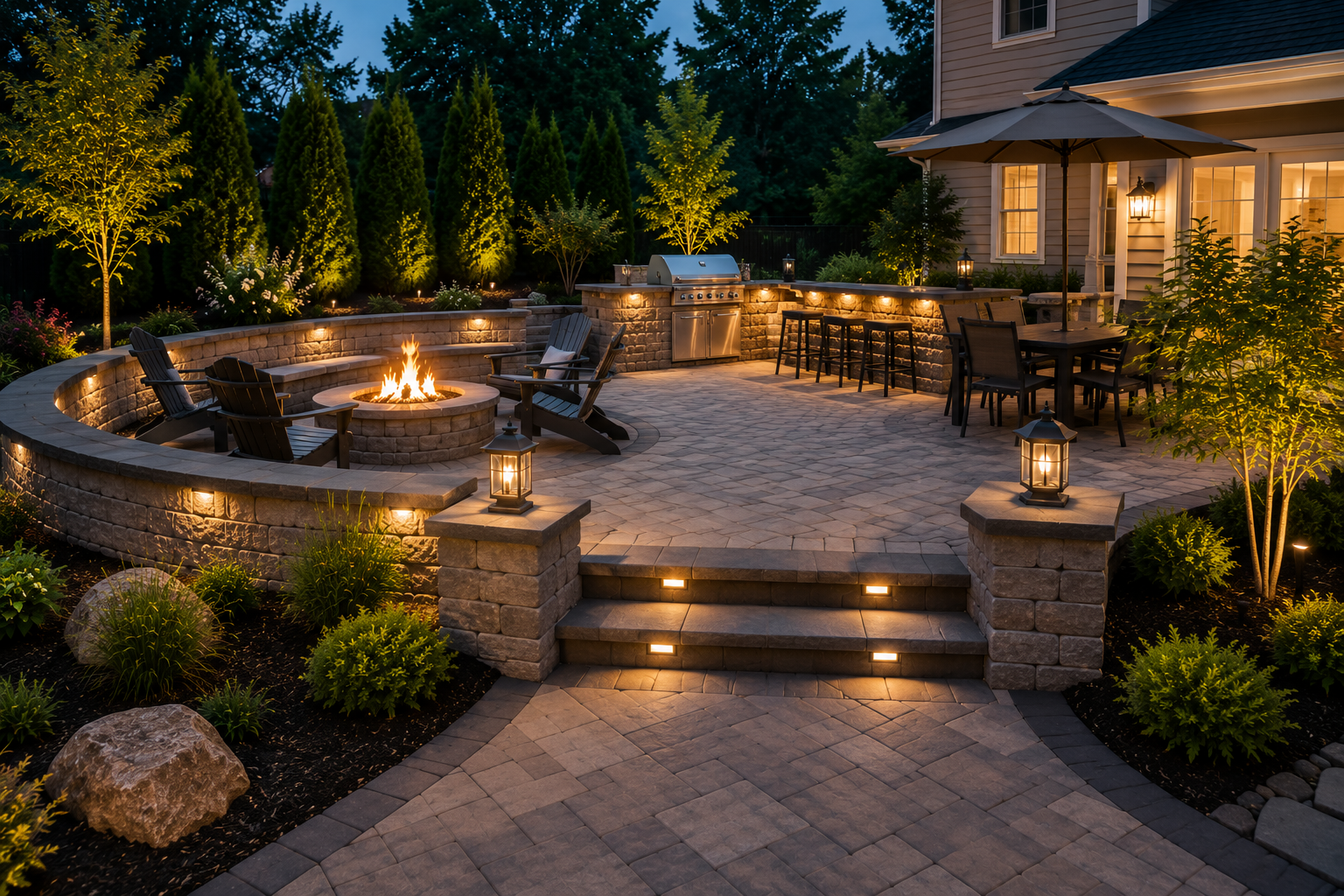
Most people invest heavily in a yard they can only enjoy for about eleven hours a day. Landscape lighting is what buys back the other half.
That framing sounds like a sales line. It is closer to a math problem. If you have spent real money on a patio, a stone wall, mature plantings, or a facade worth looking at, and all of it goes black at sunset, you are getting partial return on the whole property. Lighting is usually the smallest line item in a project and the one clients tell us afterward they wish they had done first.
We design and install landscape lighting throughout Yardley, Newtown, Villanova, Radnor, and Doylestown, as a standalone service and as the final layer on outdoor living spaces we build.
Three things, in order of how much clients end up caring about them.
It creates usable hours. A lit patio in Newtown is a patio people sit on in October. An unlit one is a patio people look at through a window.
It handles safety without looking like it. Steps, grade changes, and walkway edges are where people fall. Good lighting solves that quietly, without the runway-strip effect of a dozen identical fixtures marching down a path.
And it does something for the house that daylight cannot. At night you control exactly what the eye sees. A well-lit facade in Villanova or Radnor reads better after dark than it does at noon, because you have edited out everything you did not want in the frame.
Fixtures are commodities. Technique is not. This is where a designed system separates from a box of lights from a big-box store.
A fixture at the base of a tree or architectural feature, aimed up. This is the highest-impact move in the toolkit. A mature specimen tree lit from below becomes the centerpiece of a Yardley property at night. Beam angle matters enormously here. Too narrow and you get a spotlight, too wide and you wash out the texture that made the tree worth lighting.
The most commonly overdone technique on the list. The goal is pools of light that overlap just enough to read the path, not a continuous glowing runway. We typically space fixtures far wider than homeowners expect, and stagger them rather than pairing them across the walkway. It looks intentional instead of institutional.
Wash lighting throws even, soft light across a broad surface. Grazing puts the fixture close to a textured surface and rakes light across it at a sharp angle, which throws every joint and irregularity into relief. On a stone wall or a rough facade in Doylestown, grazing is dramatic. On a flat stucco surface it just shows you every flaw.
Fixtures mounted high in a tree canopy, aimed down, throwing dappled light and real leaf shadow across the ground below. It is the most natural-looking effect available and it takes the most skill to place. When it works, nobody can identify why the space feels good. That is the point.
Nearly everything we install runs at twelve volts through a transformer. There are practical reasons.
It is safe to work around. Fixtures can be relocated as plantings mature, and they will mature, which is why a system designed around today’s shrub size is a system that will be wrong in four years. Low voltage lets you adjust instead of re-excavate.
The LED sources we specify draw very little power and run for years. That combination, low draw and long life, is why the running cost of a full system surprises people on the low side.
One thing worth being direct about: transformer sizing and wire gauge are where cheap installations fail. Undersize either and the fixtures at the end of the run go dim. It is invisible on day one and obvious on day two hundred.
Too many fixtures. The instinct is to light everything, and the result is a yard with no contrast and no focus. Darkness is a design element. A lighting plan needs shadow the way a photograph does.
Wrong color temperature. Cool white light makes plant material look dead and stone look gray. We stay warm, in the range that flatters both, and we keep it consistent. Mixing temperatures across one property is the single most common tell of an unplanned system.
Glare. If you can see the bulb, the fixture is aimed wrong or shielded wrong. You should see the lit object, not the source.
And fixtures buried in mulch by year three, because nobody planned for the beds to grow.
Lighting is the layer that makes existing hardscape work at night.
Paver patios get seating-area lighting and step illumination. Retaining walls can take integrated fixtures under the cap course, which throws a soft wash down the wall face and lights the ground without a single visible fixture. That detail has to be planned during wall construction, not after, which is why we prefer to design lighting and hardscape together.
For clients in Yardley, Newtown, Villanova, and Radnor, lighting is typically the final phase of a larger outdoor living build. Our design process accounts for it from the start, and our lighting projects show what the result looks like after dark.
It scales with fixture count, transformer capacity, and wire runs. A focused system lighting a facade and a front walkway sits well below a full-property design covering trees, hardscape, and multiple zones. Because low voltage systems expand cleanly, phasing across seasons is a legitimate strategy.
Yes. Low voltage runs shallow, and we can trench through established beds and lawn with minimal disruption. Retrofitting is routine. The one exception is lighting integrated into a wall or step, which really wants to be planned during construction.
Quality LED fixtures typically run tens of thousands of hours, which for evening use translates to many years. The failure point in most systems is not the LED, it is the connections and the transformer. Both come down to install quality.
An LED low voltage system draws a small fraction of what people expect. Even a substantial multi-zone system on a timer adds a modest amount monthly. It is one of the cheapest improvements to run that you can put on a property.
Some form of control, yes. Astronomic timers track sunset through the year automatically so you are not resetting the schedule every few weeks. Smart controls add zone and dimming control from a phone. Both are worth it. Neither is complicated.
The fastest way to understand what lighting does is to walk a lit property at night. Photos undersell it.
We design and install landscape lighting across Yardley, Newtown, Villanova, Radnor, and Doylestown. Schedule a lighting design consultation and we will walk your property, identify what is worth lighting, and show you what it looks like before we install anything.